
If you searched for mown meaning, you’re probably wondering whether “mown” is slang, a typo, or a normal English word.
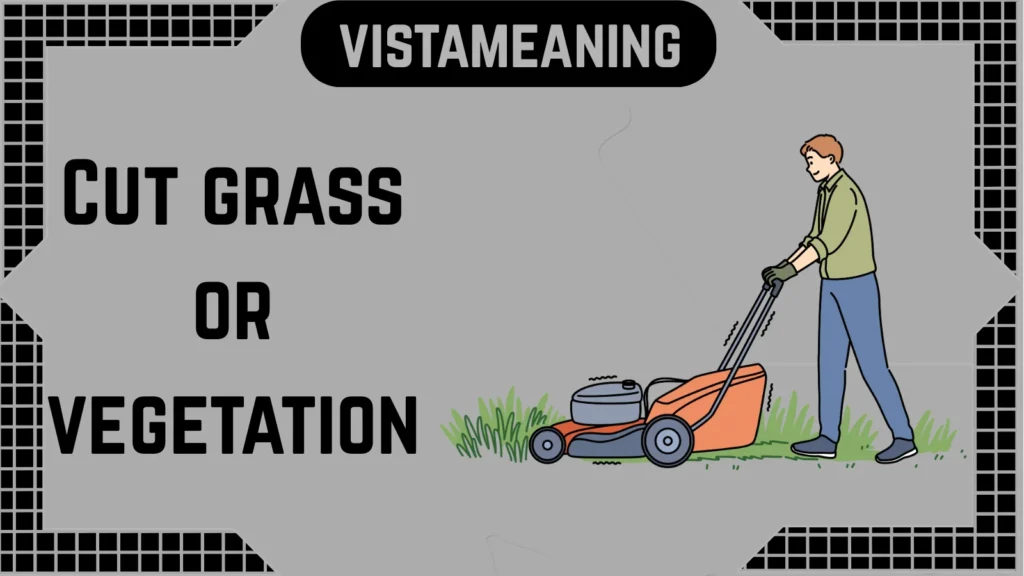
Mown is the past participle of mow, meaning grass, plants, or another area of vegetation has been cut, usually with a lawn mower or similar tool.
It is mainly used in standard English, not internet slang.
What Does “Mown” Mean?
Mown means cut down or trimmed, especially grass or vegetation. It is the past participle of the verb mow. For example, “The lawn has been mown” means someone has already cut the grass. Unlike many modern texting terms, mown is not normally an abbreviation or slang word.
Featured Snippet Answer
Mown means grass, crops, or other vegetation that has been cut. It is the past participle of mow. For example, “The lawn has been mown” means the grass has already been cut, usually with a lawn mower. “Mown” is a standard English word rather than internet slang.
Mow, Mowed, or Mown?
This is where many English learners get confused.
| Form | Example |
|---|---|
| Mow | I need to mow the lawn. |
| Mowed | I mowed the lawn yesterday. |
| Mown | The lawn has been mown. |
Mow is the base form.
Mowed is commonly used as the simple past.
Mown is the traditional past participle, especially after have, has, or had.
For example:
- “She mowed the grass yesterday.”
- “She has mown the grass.”
- “The field had been mown before the rain.”
In American English, mowed can also be used as a past participle in some contexts, but mown remains a standard and widely recognized form.
Is “Mown” Slang?
No. Mown is not generally internet slang.
If you see it in a text, social media post, article, or conversation, it will usually have its normal English meaning: cut, especially grass or vegetation.
That makes mown meaning in text quite different from abbreviations such as “TBH,” “IMO,” or “WYLL.” There is usually no hidden Gen Z meaning to decode.
Origin of “Mown”
“Mown” comes from the verb mow, an old English word associated with cutting grass or crops. The word has been used for centuries, long before modern lawn-care equipment existed.
Historically, people often mowed grass and crops with hand tools such as scythes. Today, the word is strongly associated with lawns, fields, gardens, and agricultural land.
Why Context Matters
“Mown” almost always relates to something that has been cut, but the exact thing being cut depends on the sentence.
For example:
- mown lawn → grass has been cut
- mown field → vegetation or crops have been cut
- mown grass → grass has been cut
- freshly mown grass → grass was cut recently
So if someone writes, “I love the smell of freshly mown grass,” they are talking about the familiar smell of grass after it has been cut.
Where Is “Mown” Used?

Because mown is a normal English word rather than slang, you can find it across many types of communication.
Text Messages
People may use “mown” in everyday messages about gardening or household chores.
“The backyard has finally been mown.”
Here, it simply means the grass has been cut.
TikTok
On TikTok, “mown” might appear in gardening, lawn-care, farming, landscaping, or home-improvement content.
A caption such as:
“Freshly mown lawn 😍”
is simply describing a recently cut lawn.
Instagram posts about gardens, homes, landscaping, and farms may use the word.
“Nothing beats freshly mown grass.”
Again, there is no special slang meaning.
Snapchat
A Snapchat message could say:
“Dad got the lawn mown before the party.”
The meaning is straightforward: the lawn was cut.
Discord
In a gaming server, “mown” would not normally have a special gaming meaning. If it appears in a sentence about a lawn or field, it keeps its ordinary meaning.
Reddit users may use “mown” when discussing lawn care, gardening, farming, landscaping, or even the smell of freshly cut grass.
Gaming Chats
There is no widely recognized gaming slang meaning for mown. If you see the word in gaming content, check the surrounding sentence rather than assuming it is an abbreviation.
Dating Apps
“Mown” is not a common dating abbreviation. If someone uses it in a dating conversation, it will probably refer to grass or another literal context.
You may see “mown” in posts about yards, gardening, farms, or home projects.
X
On X, the word can appear in ordinary English posts, especially when people discuss lawns, nature, farming, or gardening.
The key point: the platform usually does not change the meaning of “mown.”
Real “Mown” Examples

Here are realistic examples showing how the word works in everyday communication.
1. “The lawn has been mown.”
Meaning: Someone has cut the lawn.
Tone: Neutral.
Context: Household chores.
Why used: “Mown” describes the completed action.
2. “The grass needs to be mown.”
Meaning: The grass is too long and should be cut.
Tone: Casual.
Context: Gardening.
Why used: It describes something that needs doing.
3. “I love the smell of freshly mown grass.”
Meaning: The speaker likes the smell of grass after it has been cut.
Tone: Friendly and descriptive.
Context: Everyday conversation.
Why used: “Freshly mown” is a common phrase.
4. “Has the backyard been mown yet?”
Meaning: Has someone cut the backyard grass?
Tone: Casual.
Context: Family or roommates.
Why used: The speaker is asking whether the job is finished.
5. “The field was mown before sunset.”
Meaning: The field’s grass or vegetation was cut before sunset.
Tone: Neutral.
Context: Farming or land care.
Why used: It describes a completed task.
6. “We finally got the lawn mown.”
Meaning: The lawn was finally cut.
Tone: Casual, slightly relieved.
Context: Home maintenance.
Why used: The speaker had probably delayed the job.
7. “The garden looks great now that it’s mown.”
Meaning: The grass or vegetation looks better after being cut.
Tone: Positive.
Context: Gardening.
Why used: It explains why the garden looks different.
8. “Who mown the grass?”
This is incorrect grammar.
A better version is:
“Who mowed the grass?”
Or:
“Who has mown the grass?”
Why: “Who” is asking about the person who performed the action. “Mowed” works as simple past.
9. “The grass had been mown earlier.”
Meaning: Someone had already cut the grass.
Tone: Neutral.
Context: Storytelling or explanation.
Why used: “Had been mown” shows an earlier completed action.
10. “Freshly mown fields look beautiful.”
Meaning: Fields that have recently been cut look beautiful.
Tone: Descriptive.
Context: Nature or photography.
Why used: It describes the appearance of the fields.
11. “Can you get the lawn mown today?”
Meaning: Can you arrange to have the lawn cut today?
Tone: Casual request.
Context: Family or household conversation.
Why used: It asks someone to complete the task.
12. “The grass was just mown.”
Meaning: Someone cut the grass very recently.
Tone: Casual.
Context: Everyday conversation.
Why used: “Just” emphasizes how recently it happened.
13. “The park’s grass had been freshly mown.”
Meaning: Workers had recently cut the grass.
Tone: Descriptive.
Context: Public spaces.
Why used: It describes the condition of the park.
14. “The farmer had mown the field.”
Meaning: The farmer had cut the vegetation or crop.
Tone: Neutral.
Context: Agriculture.
Why used: It describes a completed farming task.
15. “Is the grass mown already?”
Meaning: Has someone already cut the grass?
Tone: Casual.
Context: Home or garden.
Why used: The speaker is surprised that the job may already be finished.
When Do People Use “Mown”?
Unlike internet abbreviations, mown is not tied to a particular online situation.
Casual Chatting
You might use it while talking about chores:
“The lawn’s finally been mown.”
Joking
Someone might jokingly complain:
“My weekend plans? Get the garden mown.”
The humor comes from the situation, not from a slang meaning.
Flirting
There is no standard flirting meaning for “mown.” If someone uses it while flirting, the surrounding conversation gives it meaning.
Gaming
“Mown” is not standard gaming slang. Don’t automatically assume it means something like “defeated” or “destroyed.”
Arguments
It can appear during arguments about household chores:
“I asked you to get the lawn mown!”
Here, the word is still completely literal.
Group Chats
Friends or family members might discuss yard work using the word.
Memes
A meme could use “freshly mown grass” as part of a joke, but the meme’s context creates the humor.
Online Communities
Gardening, landscaping, farming, and home-improvement communities are especially likely to use mown.
Common Mistakes With “Mown”
Mistake 1: Thinking It Is Slang
“Mown” looks unusual to some people, but it is a normal English word.
Mistake 2: Confusing “Mown” With “Mowed”
Both forms relate to mow, but their grammatical roles differ.
- I mowed the lawn.
- I have mown the lawn.
Mistake 3: Saying “I Mown the Lawn”
This is incorrect.
Say:
“I mowed the lawn.”
Or:
“I have mown the lawn.”
Mistake 4: Assuming Every Online Word Is Slang
Not every unfamiliar word on TikTok, Reddit, Discord, or Snapchat is slang. Sometimes it is simply standard English.
Mistake 5: Using “Mown” Everywhere
“Mown” generally works as a past participle, not as the normal simple-past form in American English.
Instead of:
“I mown the lawn yesterday.”
use:
“I mowed the lawn yesterday.”
How to Reply When Someone Uses “Mown”
Since “mown” is not usually slang, you don’t need a special slang response.
Casual Reply
“Nice! It probably looks much better now.”
Funny Reply
“Finally! The grass can breathe again 😂”
Neutral Reply
“Okay, thanks for letting me know.”
Safe Reply
“Got it.”
Ask for Clarification
If the sentence doesn’t make sense:
“Do you mean the grass was cut?”
That’s a perfectly natural way to confirm the meaning.
Is “Mown” Still Popular in 2026?
Yes, mown is still a normal English word in 2026, but it is not a trending slang term.
Its use is most natural in writing and speech involving:
- lawns
- gardens
- fields
- farming
- landscaping
- nature
- household chores
Gen Z and Millennials may use the word online, but they generally aren’t using mown as a new abbreviation or secret texting term.
If you’re looking for a modern slang meaning, there probably isn’t one. The safest interpretation is the ordinary English meaning unless the surrounding conversation clearly suggests otherwise.
Similar Words and Abbreviations
| Word or Term | Meaning | Tone | Common Platform |
|---|---|---|---|
| Mown | Cut grass or vegetation | Neutral | General English |
| Mowed | Cut grass or vegetation | Neutral | General English |
| Mow | To cut grass or vegetation | Neutral | General English |
| Trimmed | Cut or shortened | Neutral | General English |
| Cut | Removed part by cutting | Casual/neutral | Everywhere |
| Freshly mown | Recently cut | Descriptive | Instagram, Facebook |
| Lawn care | Maintaining grass | Neutral | Reddit, Facebook |
| Grass cutting | Cutting grass | Neutral | General English |
For your site’s internal linking, mown can naturally connect to articles about meaning in text, common English words, confusing verb forms, or other words beginners often encounter online.
Quick Reference Table
| Keyword | Meaning | Tone | Platform | Popularity | Safe to Use |
|---|---|---|---|---|---|
| mown meaning | Meaning of “mown” | Informational | Search | Common query | Yes |
| mown | Cut grass/vegetation | Neutral | All | Common word | Yes |
| mown meaning in text | Same standard meaning | Neutral | Text | Occasional | Yes |
| mown meaning in chat | Usually “cut” | Neutral | Chat | Occasional | Yes |
| mown slang meaning | No common slang meaning | Neutral | Social media | Low | Yes |
| mowed | Simple past of mow | Neutral | All | Common | Yes |
| mow | To cut grass | Neutral | All | Common | Yes |
| freshly mown | Recently cut | Descriptive | Social media | Common phrase | Yes |
Expert Tips for Understanding “Mown”
The biggest clue is grammar.
If you see mown after words such as has, have, had, been, or was, it is probably functioning as a past participle.
For example:
“The lawn has been mown.”
Compare that with:
“He mowed the lawn.”
The first sentence focuses on the completed state of the lawn. The second focuses more directly on the action performed by the person.
Also remember that context matters more than the platform. Seeing a word on TikTok does not automatically turn it into TikTok slang.
One more useful clue is the word freshly. The phrase “freshly mown grass” is extremely common and simply means grass that was cut recently.
FAQs About Mown Meaning
What does mown mean?
Mown means cut, especially when talking about grass, crops, or other vegetation. It is the past participle of mow. For example, “The lawn has been mown” means someone has already cut the grass.
Is mown a slang word?
No. Mown is not normally slang. It is a standard English word. If you see it in a text, social media post, or online conversation, it usually has its regular meaning related to cutting grass, crops, or vegetation.
What is the difference between mowed and mown?
Both come from the verb mow. “Mowed” is commonly used as the simple past, as in “I mowed the lawn.” “Mown” is commonly used as a past participle, as in “I have mown the lawn.”
What does mown mean in text?
“Mown” normally has the same meaning in text as it does in standard English: something, especially grass, has been cut. There is no widely recognized texting or Gen Z meaning for the word.
What does freshly mown mean?
“Freshly mown” means something, usually grass, has been cut recently. “Freshly mown grass” is a common phrase describing a lawn or field that has just been cut.
Is “I mown the grass” correct?
No, not in standard English. For a completed action in the simple past, say “I mowed the grass.” With a helping verb, you can say “I have mown the grass.”
Can mown be used for crops?
Yes. “Mown” can describe grass, crops, weeds, or other vegetation that has been cut. For example, “The field had been mown before the storm.”
Why does “mown” look different from “mowed”?
“Mown” is an irregular form connected to the older verb pattern of mow. English has many verbs with different simple-past and past-participle forms, which is why “mowed” and “mown” can both appear.
Conclusion
The mown meaning is much simpler than it may first appear. Mown means cut, especially when talking about grass, crops, or other vegetation.
It is the past participle of mow, while mowed is commonly used for the simple past.
You may see “mown” in texts, TikTok captions, Instagram posts, Reddit discussions, or everyday conversations, but it does not normally have a secret Gen Z or internet-slang meaning.
Look at the grammar and surrounding words to understand how it is being used.
Related Meanings
Explore more clear explanations on VistaMeaning.