

Have you ever seen the word whether in a text, email, comment, or conversation and wondered what it actually means? You’re not alone.
Whether meaning can be confusing because the word looks a little formal, yet people use it in everyday speech, texting, school, work, and online conversations.
In simple terms, whether means “if” when you are talking about uncertainty or a choice between possibilities.
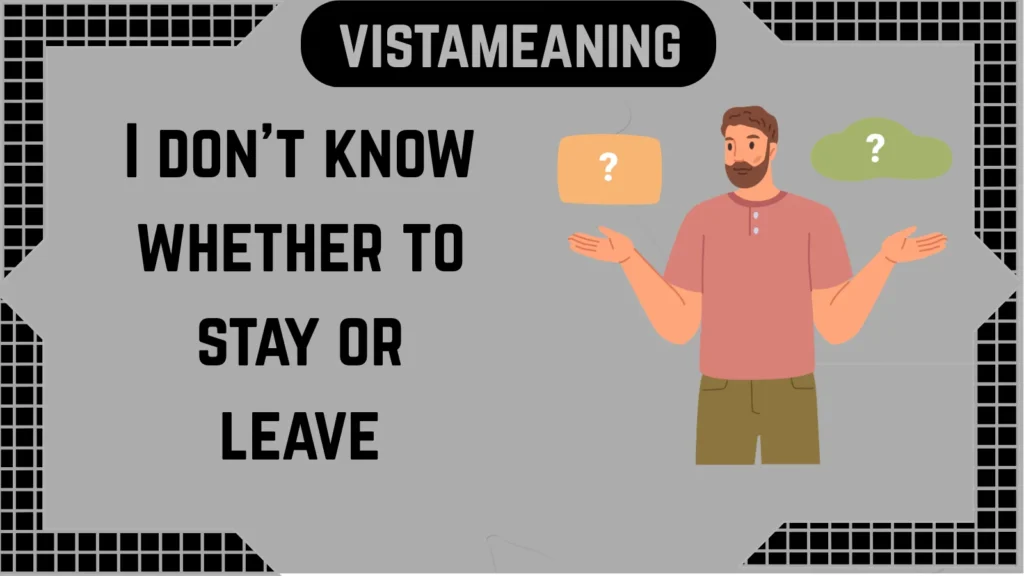
For example, “I don’t know whether she’ll come” means “I don’t know if she’ll come.” It can also introduce two alternatives, as in “I can’t decide whether to stay or leave.”
Unlike terms such as TS, YN, ASL, OTP, or MB, whether is not internet slang or a texting abbreviation.
It is a standard English conjunction. That distinction matters if you’re learning English or trying to understand a message correctly.
Let’s break down the whether meaning in text, chat, social media, and everyday English with simple examples.
What Does “Whether Meaning” Mean?
Featured Snippet Answer
Whether means “if” or introduces a choice between two or more possibilities. It is commonly used when someone is uncertain about something or needs to consider alternatives. For example, “I don’t know whether he’ll come” means “I don’t know if he’ll come,” while “Choose whether to stay or leave” presents two options.
The Simple Meaning of Whether
The easiest way to understand whether is:
whether = if / which of two or more possibilities
For example:
- “I don’t know whether he is home.”
- “She asked whether I was ready.”
- “I can’t decide whether to go.”
- “Tell me whether you agree.”
In each case, the speaker is dealing with uncertainty, a question, or a choice.
Whether Meaning in Text
When someone uses whether in text, it usually has the same meaning as it does in normal English.
Example:
“I don’t know whether I’ll be there tonight.”
This means:
“I don’t know if I’ll be there tonight.”
It does not secretly stand for another phrase. It is simply the normal English word whether.
Whether Meaning in Chat
In online chat, whether can appear in casual sentences such as:
“I’m not sure whether I should text her.”
Or:
“Idk whether he’s coming.”
Here, “idk” means “I don’t know,” while whether still has its standard English meaning.
So if you’re searching for whether meaning in chat, the answer is usually simple: it means if, or it introduces alternatives.
Is Whether Slang?
No.
Whether is not normally slang. It is a standard English conjunction used in both casual and formal communication.
You may see it on TikTok, Instagram, Reddit, Discord, Snapchat, or in text messages, but that does not make it internet slang.
Where Is Whether Used?
Because whether is a regular English word, you can find it almost anywhere people communicate.
Text Messages
People use whether when talking about uncertainty:
“I’m not sure whether I can go.”
TikTok
You might see it in captions, comments, or discussions:
“Whether you agree or not, that’s my opinion.”
The meaning stays the same.
It can appear in captions or DMs:
“I’m deciding whether to post this.”
Snapchat
A friend might write:
“Idk whether we should go lol.”
The casual tone comes from the rest of the sentence, not from the word whether itself.
Discord
In gaming or community chats:
“We need to decide whether to play tonight.”
Reddit users often use whether when discussing possibilities:
“I’m wondering whether this is actually worth buying.”
Gaming Chats
You could see:
“Not sure whether we should push or defend.”
Here, whether introduces two possible actions.
Dating Apps
A dating conversation might include:
“I’m trying to decide whether I should ask you out.”
Again, there is no special slang meaning.
Facebook and X
The word can appear in posts, replies, debates, and comments:
“Whether you like the movie or not, the soundtrack was great.”
Across all these platforms, the basic meaning remains unchanged.
Whether vs. If
This is one of the biggest sources of confusion.
In many sentences, whether and if can mean nearly the same thing.
Example
“I don’t know whether she is coming.”
and
“I don’t know if she is coming.”
Both communicate uncertainty.
However, they are not interchangeable in every situation.
A useful rule is that whether is especially useful when there are alternatives or when it comes before to + verb. Cambridge specifically notes that English uses whether, rather than if, before a to-infinitive.
Correct
“I don’t know whether to go.”
Usually Incorrect
“I don’t know if to go.”
A more natural version would be:
“I don’t know if I should go.”
Whether or Not Meaning
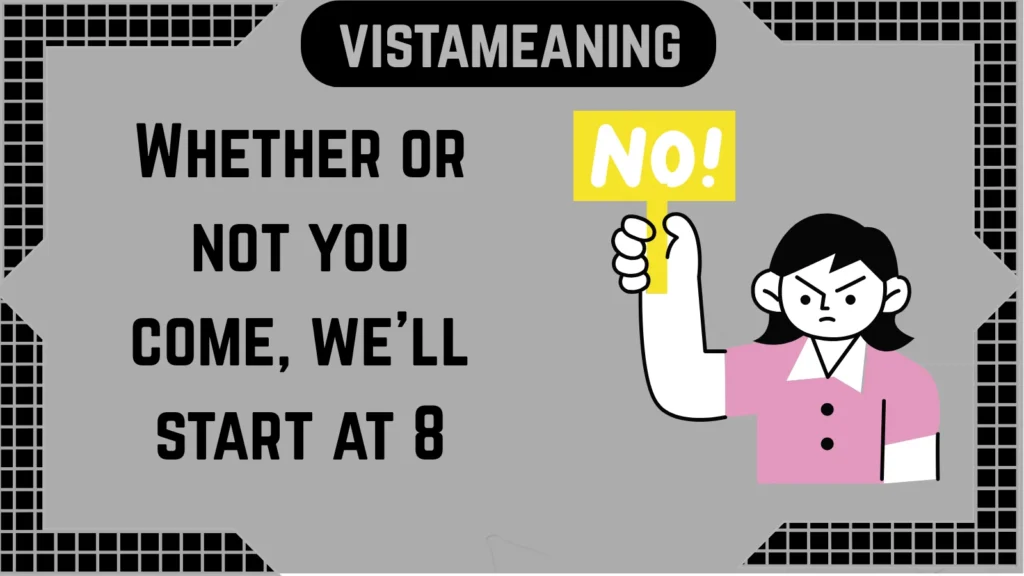
The phrase whether or not means that two possibilities are being considered, often with the idea that the result is the same either way.
For example:
“Whether or not you come, we’ll start at 8.”
This means the event will start at 8 regardless of whether you come.
Another example:
“I’m going whether or not you agree.”
The speaker is saying their decision will not change based on the other person’s opinion.
Cambridge defines whether or not as being used when it is not important which of two possibilities is true.
Whether…Or Meaning
The structure whether…or introduces alternatives.
For example:
“I don’t know whether to choose pizza or burgers.”
There are two choices.
Another example:
“She couldn’t decide whether to laugh or cry.”
The alternatives are laugh and cry.
This structure is especially useful when a person is comparing two possible actions, outcomes, or situations.
18 Real Whether Meaning Examples
Here are realistic examples showing how people use whether in everyday conversations.
1. “I don’t know whether he’s coming.”
Meaning: The speaker is unsure if he will come.
Tone: Casual.
Context: Friends discussing plans.
2. “Are you sure whether this is the right place?”
Meaning: The person wants confirmation.
Tone: Neutral.
Context: Traveling or meeting someone.
3. “I’m not sure whether I should text her.”
Meaning: The speaker is unsure about sending a message.
Tone: Casual and slightly uncertain.
Context: Dating or friendship.
4. “Let me know whether you can make it.”
Meaning: Tell me if you can attend.
Tone: Friendly.
Context: Making plans.
5. “I can’t decide whether to buy it.”
Meaning: The person is choosing whether to purchase something.
Tone: Casual.
Context: Shopping.
6. “Do you know whether the store is open?”
Meaning: Do you know if the store is open?
Tone: Neutral.
Context: Everyday conversation.
7. “Idk whether this is a good idea.”
Meaning: “I don’t know if this is a good idea.”
Tone: Very casual.
Context: Texting.
8. “I’m wondering whether he’ll reply.”
Meaning: The speaker is uncertain about getting a response.
Tone: Casual.
Context: Messaging.
9. “We need to decide whether to stay.”
Meaning: The group must choose whether to remain.
Tone: Neutral.
Context: Plans or travel.
10. “Whether you like it or not, we’re going.”
Meaning: The decision is already made.
Tone: Firm, sometimes playful.
Context: Friends or family.
11. “I don’t care whether they agree.”
Meaning: Their agreement does not matter to the speaker.
Tone: Strong or dismissive.
Context: An argument or disagreement.
12. “She asked whether I was okay.”
Meaning: She asked if I was okay.
Tone: Neutral.
Context: Conversation.
13. “I’m checking whether we have enough food.”
Meaning: The speaker is checking if the amount is sufficient.
Tone: Practical.
Context: Planning an event.
14. “Whether we win or lose, we had fun.”
Meaning: The outcome does not change the main point.
Tone: Positive.
Context: Sports or gaming.
15. “I’m not sure whether that’s true.”
Meaning: The speaker doubts the information.
Tone: Cautious.
Context: Online discussions.
16. “Choose whether you want pizza or pasta.”
Meaning: Pick one of two options.
Tone: Casual.
Context: Food.
17. “Tell me whether you’re coming.”
Meaning: Tell me if you’re coming.
Tone: Direct.
Context: Making plans.
18. “Whether it’s Monday or Friday, I’m busy.”
Meaning: The speaker is busy on either day.
Tone: Matter-of-fact.
Context: Scheduling.
When Do People Use Whether?
People use whether in several common situations.
Casual Chatting
“I’m not sure whether I can come.”
It expresses uncertainty without sounding unusual.
Joking
“Whether you admit it or not, you love this song.”
The speaker may be teasing someone.
Flirting
“I’m deciding whether to ask you out.”
This can sound playful or nervous depending on context.
Gaming
“We need to figure out whether to attack now.”
It introduces two possible decisions.
Arguments
“Whether you believe me or not, it’s true.”
This can sound firm or defensive.
Group Chats
“Can someone check whether we’re still meeting tonight?”
It is a natural way to ask about plans.
Memes and Online Posts
“Whether you’re ready or not, Monday is coming.”
Here, the phrase may be used humorously.
Common Mistakes With Whether
1. Confusing Whether With Weather
This is probably the most common spelling mix-up.
Whether relates to choices or uncertainty.
Weather means conditions such as rain, wind, heat, or snow.
Compare:
“I don’t know whether he’ll come.”
vs.
“The weather is terrible today.”
They sound similar, but they have completely different meanings.
2. Writing “Wheter” or “Wheather”
These are misspellings.
The correct spelling is:
whether
Cambridge specifically lists common incorrect spellings such as “weather,” “wheter,” “wheather,” and “wether.”
3. Using If Before To
A common learner mistake is:
“I don’t know if to go.”
Use:
“I don’t know whether to go.”
Or:
“I don’t know if I should go.”
4. Thinking Whether Is Slang
It isn’t.
Seeing whether in a TikTok comment or Discord message does not give it a special internet meaning.
How to Reply When Someone Uses Whether
You don’t need a special response just because someone says whether.
Simply answer the question or possibility being discussed.
Casual Reply
“Yeah, I think I’ll go.”
Neutral Reply
“I’m not sure yet.”
Funny Reply
“Whether I go depends on whether there’s free food.”
Safe Reply
“Let me think about it and I’ll let you know.”
If You Don’t Understand
Ask:
“Do you mean if I’m coming?”
That is perfectly natural and can quickly clear up confusion.
Is Whether Still Popular in 2026?
Yes. But calling it “popular slang” would be misleading.
Whether remains a standard English word in 2026, used in everyday conversation, writing, education, business communication, journalism, and online communication. Current learner and American English dictionary resources continue to define it as a conjunction used for uncertainty, indirect questions, and alternatives.
Gen Z and Millennials may use simpler alternatives such as if, especially in quick messages:
“Idk if he’s coming.”
But that does not mean whether is disappearing.
The two words simply have different levels of flexibility.
Modern Alternatives
Depending on the sentence, you might see:
- if
- whether or not
- if or not
- which one
- should I
- is it possible that
For example:
“I don’t know whether she’ll come.”
can often become:
“I don’t know if she’ll come.”
The second version is especially common in casual conversation.
Similar Words and Abbreviations
| Term | Meaning | Tone | Common Platform |
|---|---|---|---|
| whether | If; one of two or more possibilities | Neutral | Everywhere |
| if | Introduces a condition or possibility | Casual/neutral | Everywhere |
| whether or not | Regardless of which possibility is true | Neutral/firm | Everywhere |
| IDK | I don’t know | Casual | Texting/social media |
| TBH | To be honest | Casual | Texting/social media |
| IMO | In my opinion | Casual | Social media/forums |
| YN | Can have different meanings depending on context | Casual | Online |
| ASL | Can mean age, sex, location in older chat usage; also other meanings | Casual | Chat/social media |
For a slang-focused site, whether can naturally link to articles about IDK, TBH, IMO, ASL, and other texting terms. The key distinction is that whether itself is a regular English word, not an abbreviation.
Quick Reference Table
| Keyword | Meaning | Tone | Platform | Popularity | Safe to Use |
| whether | If or a choice between possibilities | Neutral | All | High | Yes |
| whether or not | Regardless of the outcome | Neutral/Firm | All | High | Yes |
| whether…or | Presents alternatives | Neutral | All | High | Yes |
| if | Condition or possibility | Casual/Neutral | All | Very High | Yes |
| IDK | I don’t know | Casual | Texting | High | Usually |
| TBH | To be honest | Casual | Social media | High | Usually |
| IMO | In my opinion | Casual | Social media | High | Usually |
Expert Tips for Using Whether Correctly
Here are a few simple rules that make whether meaning in text and chat much easier to understand.
Think “Two Possibilities”
When you’re unsure between possibilities, whether often fits naturally.
“I don’t know whether to stay or leave.”
Think:
Option A or Option B?
Think “If”
In many sentences, replacing whether with if will help you understand the meaning.
“I don’t know whether she’s home.”
Think:
“I don’t know if she’s home.”
Watch for “Whether or Not”
When you see whether or not, think:
“No matter which possibility is true.”
Example:
“I’ll go whether or not you come.”
The speaker’s decision stays the same.
Don’t Overthink Social Media Context
If you see whether on Instagram, TikTok, Reddit, Snapchat, or Discord, don’t assume it is hidden slang.
Check the sentence first.
Usually, it simply means if or introduces alternatives.
Check the Spelling
Remember:
whether = choice or uncertainty
weather = rain, sunshine, temperature, etc.
One extra letter can completely change the meaning.
FAQs
What does whether mean in simple English?
Whether usually means “if” when talking about uncertainty. It can also introduce a choice between two or more possibilities.
What does whether mean in text?
The whether meaning in text is the same as in standard English. It usually means “if” or introduces alternatives. It is not a special texting abbreviation.
Is whether slang?
No. Whether is a standard English conjunction, not internet slang. People can use it in texts, DMs, comments, and online chats, but its meaning does not change.
What does whether or not mean?
Whether or not means that it does not matter which possibility is true. For example, “I’ll go whether or not you come” means the speaker will go either way.
What is the difference between whether and if?
They can have the same meaning in many sentences. However, whether is especially useful when presenting alternatives and is required in some structures, such as whether to go.
Is whether used on TikTok and Instagram?
Yes. You can see whether in captions, comments, DMs, and discussions. However, it is being used as normal English rather than as a platform-specific slang term.
Is whether formal or casual?
It can be both. It works in everyday speech and texts, but it may sound slightly more formal than if in some casual sentences.
Why do people confuse whether and weather?
They sound similar in many accents. Whether relates to uncertainty or choices, while weather describes outdoor conditions such as rain, wind, heat, and snow.
Conclusion
The easiest way to remember the whether meaning is this: whether usually means
“if” or introduces a choice between possibilities.
You might see it in a text like “I don’t know whether I’ll go,” where it means “I don’t know if I’ll go.”
You can also see it in phrases such as whether or not and whether…or, which are used to discuss alternatives or outcomes.
Related Meanings
Explore more clear explanations on VistaMeaning.